Introduction
For freshwater anglers, few pursuits rival the challenge and mystique of trophy muskie fishing. These apex predators sit at the very top of the food chain, occasionally even preying on northern pike, and their sheer size and belligerence turn an ordinary day on the water into an instant fish story the moment a giant follows your lure. Catching a true trophy muskie demands specialized gear, a deep understanding of their behavior, and the mental fortitude to keep casting when the action is slow. This guide breaks down everything you need to know, from identifying a trophy and telling a muskie from a pike to choosing the right lures and executing the famous figure-8.

What Makes a Muskie a Trophy?
The definition of a trophy muskie changes dramatically depending on where you fish. Regulations are universally based on length, but many state record categories also consider weight when a fish is taken on a specific line class. In Pennsylvania, a legal muskie must measure at least 40 inches; inland waters in Minnesota push that minimum all the way to 54 inches. To put that in perspective, seven species of shark in Florida carry the same 54-inch minimum size limit. For bass, walleye, and trout anglers accustomed to trophies that could practically double as muskie bait, these numbers are hard to wrap your head around. Always check local regulations before targeting muskies because size limits exist to protect a naturally low-density population.
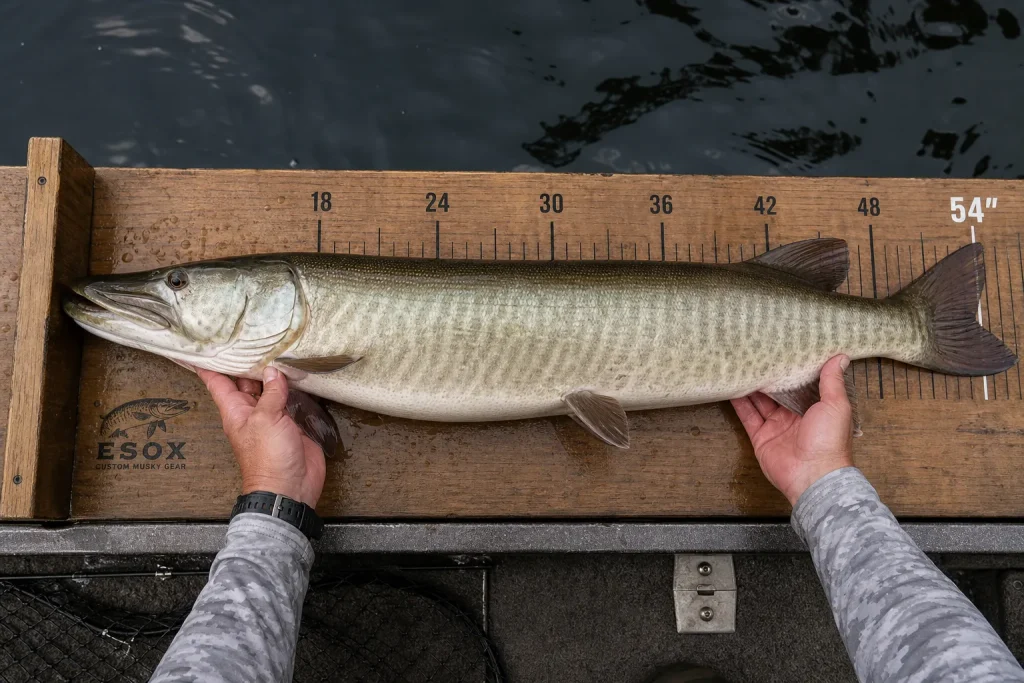
Muskie vs. Pike: Spotting the Difference
At a glance, a muskie and a northern pike look similar, but a few key features make identification straightforward once you know what to look for. Muskie display dark vertical bars or spots on a lighter background, whereas pike have lighter, bean-shaped spots on a dark green body. Check the cheek and gill cover: a muskie has scales only on the upper half, while a pike’s cheek and opercle are fully scaled. The tail tells the same story—muskie fins come to distinctly sharper points, while a pike’s tail has more rounded lobes. The two species are so closely related they can hybridize naturally, producing the beautifully marked tiger muskie, which often exhibits a mix of both patterns and adds another exciting layer to muskie fishing.
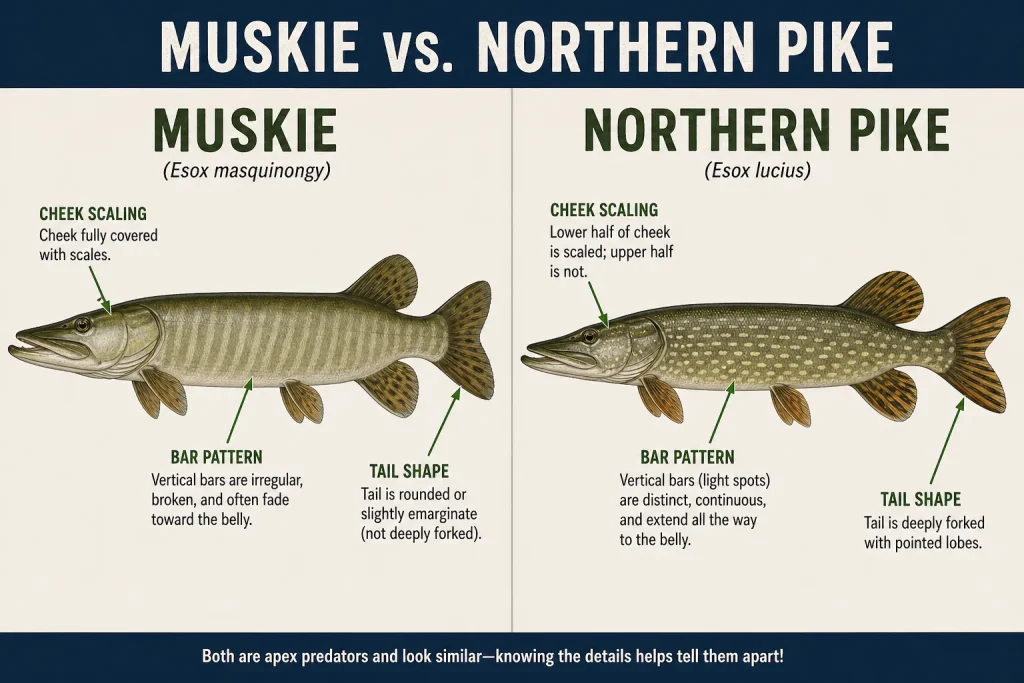
The Apex Predator’s Habitat and Low-Density Reality
Muskie and pike share similar habitat preferences—both gravitate to vegetation, slack water areas, and shallow bays with access to deeper, cooler water. However, pike typically have much higher natural reproduction rates, making them far more common in northern lakes and rivers. In Fishes of the Allegheny, Dr. Turner described muskie populations as “widespread, but never abundant,” and that statement holds true across most of their range. Sitting alone at the top of the food web and even consuming pike, muskies simply cannot exist in great numbers. This natural scarcity is precisely why trophy muskie fishing feels like hunting a ghost—it takes hundreds or even thousands of casts to move a single big fish.
Essential Gear for Trophy Muskie Fishing
Trophy muskie fishing requires heavy-duty tackle from end to end. You’ll need a long, stout rod rated for extra-heavy lures, a large-capacity reel spooled with 80- to 100-pound-test braided line, and—critically—a wire or heavy fluorocarbon leader. Muskie teeth will slice through standard monofilament instantly, so a bite leader is non-negotiable. The lures you throw often look comically large to newcomers: foot-long jointed crankbaits, magnum spinnerbaits, and topwater prop baits the size of a hoagie roll. These giant baits don’t just mimic suckers, trout, or perch; some muskie patterns intentionally imitate ducklings, loons, or even muskrats. That alone tells you something about the predatory capabilities of a fish that routinely tops 40 pounds.
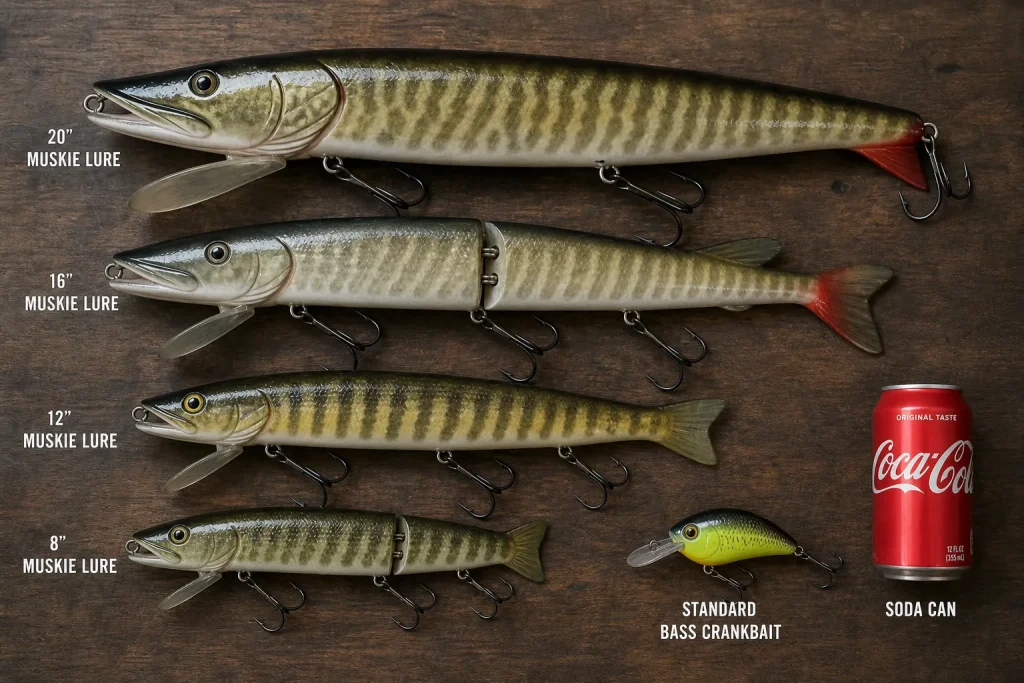
Lure Selection and the Art of the Follow
One of the most distinctive and maddening traits of the muskie is the “follow”—when a fish stalks your lure all the way to the boat but refuses to commit. I still remember a heart-pounding moment with my son when an enormous muskie created a slow, Jaws-like torpedo wake behind a topwater prop bait. It trailed for several breathless seconds before melting into the depths. We immediately went into a figure-8, tracing a wide, smooth pattern in the water with the rod tip just below the surface, but the fish simply vanished. That experience is textbook muskie behavior.
The figure-8 technique works because it presents a sudden, erratic change of direction that can trigger a reaction strike from a following fish. Make large, lazy loops at boatside, and never slow the lure down or stop—the moment a muskie loses the illusion of a fleeing meal, it will turn away. Topwater baits, bulldawgs, and large rubber-tailed inline spinners all excel at drawing these nerve-wracking follows. Whenever you see a fish materialize behind your lure, resist the urge to set the hook or pause. Keep the bait moving and transition into the figure-8 in one fluid motion; many trophy muskies are caught within feet of the boat.
[Internal Link: Minnow Lures]
Seasonal Tactics for Trophy Muskies
Muskies will strike year-round as long as plenty of cool, well-oxygenated water is available, but certain windows increase your odds. Cooler months—late fall through early spring—often produce better action because dropping water temperatures concentrate baitfish and reduce recreational boat traffic. During pre-spawn and post-spawn periods, fish move into shallow weedy bays and along wind-blown points, making them more predictable. In summer, look for muskies relating to deep weed edges, mid-lake humps, or suspended schools of cisco and whitefish. The common thread is oxygen and forage; if you find those, you’ll find muskies.
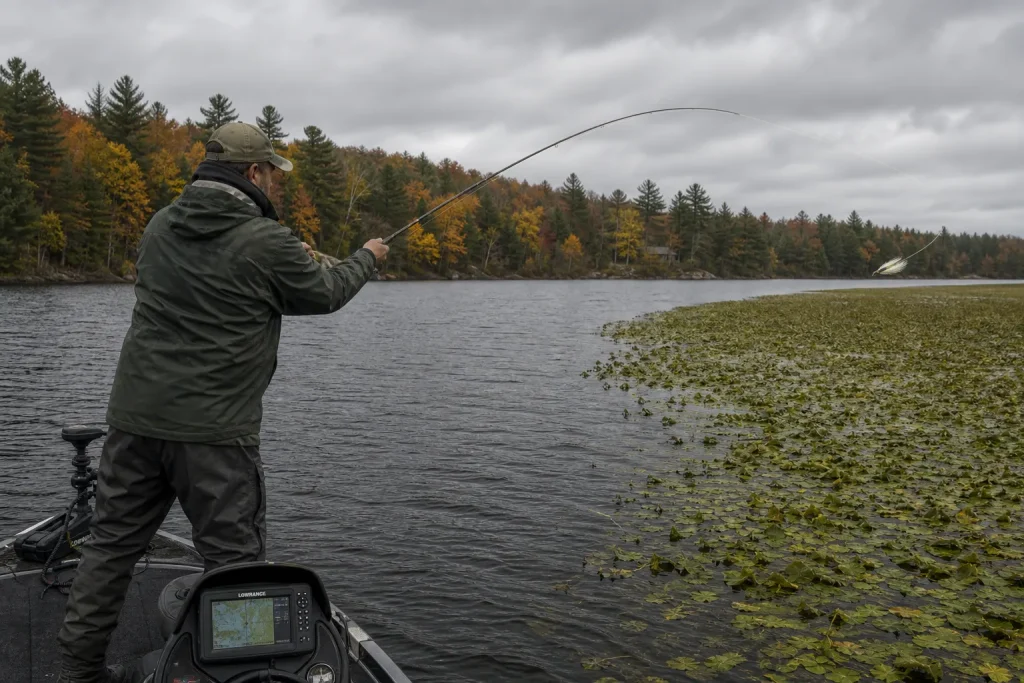
The Mental Game: Patience, Persistence, and a Little Paranoia
Because of their low density, trophy muskie fishing is a numbers game that punishes impatience. Long trolling passes and thousands of casts are the norm, not the exception. After that massive follow that my son and I witnessed, we calmed down and went back to catching small crappies—but we immediately switched to lifting every panfish into the boat rather than lipping them at the water’s surface. We were utterly convinced that a trophy muskie was still watching from the shadow line beneath the boat. That kind of heightened awareness and respect for the fish is part of the pursuit. When you’re in muskie water, assume a giant is always looking up.
Practical Fishing Tips
- Landing and handling: Use a large, rubber-coated net and never lift a trophy muskie vertically by the jaw; support the belly horizontally to protect internal organs.
- Release tools: Carry long-nose pliers, jaw spreaders, and hook cutters to quickly free deeply hooked fish.
- Cast count mindset: Don’t get discouraged by a slow day. Treat every cast as a step closer to moving a fish.
- Weather windows: Overcast skies, light chop, and falling barometric pressure often trigger increased muskie activity.
- Stealth matters: Approach spots quietly with the trolling motor and avoid slamming hatches—muskies can feel those vibrations.
Common Mistakes
- Skipping the wire leader: Even small pike can cut braid; with a muskie, it’s an almost guaranteed lost lure and a dead fish swimming around with a mouthful of hardware.
- Stopping the retrieve on a follow: The moment you pause, the jig is up. Keep the lure moving or you’ll watch the fish fade away.
- Fishing too small: While you can catch a muskie on bass gear, truly big fish demand big baits and heavy tackle to ensure a quick fight and safe release.
- Ignoring the figure-8: Many anglers reel up too early. Always finish every cast with at least two lazy figure-8 turns before lifting the lure out of the water.
FAQ
1. How big does a muskie have to be to be considered a trophy?
Definitions vary by state. In Pennsylvania the minimum is 40 inches, while Minnesota inland waters require 54 inches. Generally, any muskie over 50 inches is regarded as a trophy class fish.
2. What’s the easiest way to tell a muskie from a northern pike?
Look at the markings (dark bars on a light body for muskie, light spots on a dark body for pike), the scale coverage on the cheek and gill cover (musky have scales only on the upper half), and the tail points (sharper on a muskie, rounded on a pike).
3. Why do muskies follow a lure without striking?
Follows are a natural hunting behavior where the fish inspects potential prey. The figure-8 technique exploits this by creating an unpredictable change of direction that can trigger a reaction bite at boatside.
4. What gear do I absolutely need for trophy muskie fishing?
A heavy power rod (8’6” or longer), a large-capacity reel filled with 80-100 lb braid, a wire or heavy fluorocarbon leader, and a selection of oversized lures like jointed crankbaits, bucktails, and topwater prop baits.
5. Is it true that muskie lures sometimes imitate ducks or muskrats?
Yes. Because large muskies are capable of taking waterfowl and small mammals, some big topwater and wake bait designs mimic ducklings or swimming rodents to provoke predatory strikes.